
Somatic therapy in Melbourne
Body-based trauma therapy in Thornbury and Elsternwick
I work with people whose nervous systems haven't caught up with the fact that the hard thing is over. They're often living with the aftereffects of trauma, or with a body that won't settle.
I'm Rudi Doku, a Somatic Experiencing® Practitioner. I see people in person in Thornbury and Elsternwick, and online across Australia.
The first call is free and takes 45 minutes.
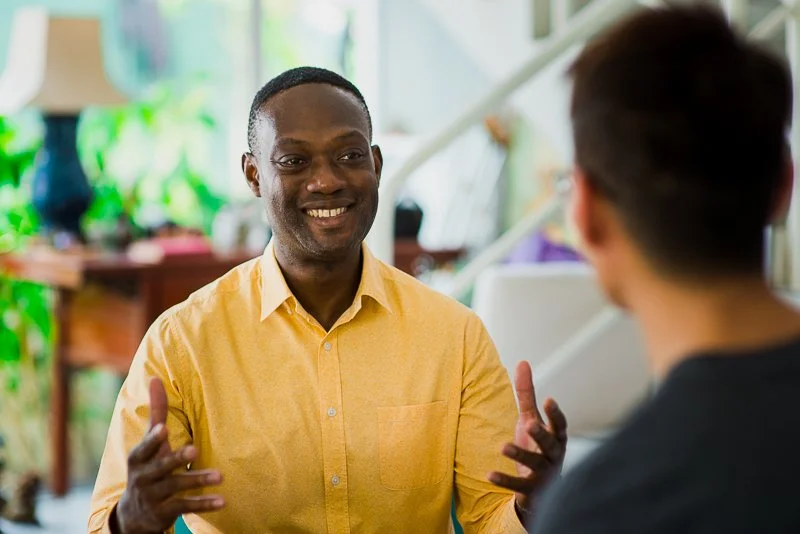
Somatic therapy, briefly
Somatic therapy is a broad term for approaches that work through the body as well as conversation. Attention goes to sensation and the pace of the nervous system, because that's often where a pattern lives when thinking about it hasn't been enough.
My main training is Somatic Experiencing® (SE), developed by Dr Peter Levine. He started from the observation that animals in the wild seem to recover from life-threatening events without lasting trauma, and that humans often don't. In SE's view, a nervous system can get caught in the middle of a survival response that never finished. Seeing it that way takes the shame out of it.
A fuller explanation is on the Somatic Experiencing® in Melbourne page
How this tends to show up
People describe freezing the moment someone raises their voice, or hearing themselves say yes when everything in them means no. Worry can follow them from room to room without a clear reason. At night they replay conversations and brace for things that haven't happened yet.
For some it's more visible, such as flashbacks and nightmares, or a short fuse that surprises even them.
A clear trauma, or a relationship that broke someone, is a common way in. So is grief that has settled into the body after a death or the end of a marriage. Often it's an experience they've never fully told anyone. Others just feel off. They're anxious without an obvious reason, or they've drifted from the people they love and are going through the motions of a life that should feel good and doesn't.
Many of these patterns can be understood as nervous system responses, and that's where this work starts. Anyone unsure whether what they're dealing with counts as trauma is welcome to ask on the free call.
Alongside talk therapy
Talk therapy helps many people, and several of the best-researched trauma treatments involve talking. It works mainly through language and thinking, so insight can arrive without reaching the automatic reaction underneath. For some people, going over what happened in detail leaves them more activated.
Somatic therapy adds the body to the conversation. Plenty of people use both, and I'm glad to work in parallel with their other practitioners.
Inside a session
We slow down
Sessions move deliberately slowly. We track sensations as they arise and let insight come in its own time, because the nervous system needs space to do this work.
Sensation leads
Attention goes to what you notice physically, such as tension, warmth or an impulse to move. These signals show where the nervous system got caught, and what it might need in order to finish a response that was interrupted.
The alarm settles
The idea in SE is that the survival response can complete and your capacity grows. What felt overwhelming can become more manageable. How far that goes varies from person to person.
The approaches I bring
My core training is Somatic Experiencing®, and I've trained personally with Maggie Kline and Kathy Kain. I use Internal Family Systems alongside it when that helps, and I trained in IFS with Einat Bronstein. I studied Polyvagal informed practice with Deb Dana, and I'm a certified TRE® provider as well.
Full dates and training bodies are set out below.
Where I see people
Thornbury, inner north
Melbourne Integrated Therapies
8-10 Mansfield Street
Somatic Experiencing® in ThornburyOnline
In every state and territory of Australia, and internationally. Some people start online and move to in-person sessions later.
Online somatic therapy in AustraliaThe first step is a free 45-minute call, to see whether we're a good fit and to answer any questions about the process.
Changes people sometimes report
People often arrive feeling they've lost access to themselves. Relief from symptoms is part of what the work can offer, and some people find the larger change is harder to name, a steadier base and more room to sit with discomfort without being swallowed by it.
- Sleep that settles
- Less reactivity in relationships and at work
- Holding a limit with less guilt afterwards
- Feeling more present and less braced for what's next
- A quieter inner critic and more self-compassion
- A calmer baseline, with less hypervigilance
- Apologising less for things that were never their fault
- A return to parts of themselves that felt shut down
These don't arrive on a schedule. What happened stays part of the story, and some people find it steers their days less.
The training behind this work
Somatic Experiencing® Practitioner (SEP)
Conferred by Somatic Experiencing International on 10 February 2025, after its three-year professional training plus additional supervised sessions and case consultations. The title covers somatic practice, and SEI states on the certificate that it doesn't confer a licence to practise psychotherapy.
Teaching Assistant, Somatic Experiencing International
I currently sit on the assisting team for Restoring Resilience's Melbourne Somatic Experiencing® training, with Maggie Kline as faculty trainer.
Internal Family Systems, Level 1
Completed through the IFS Institute in June 2021. Level 1 is the entry point into IFS and differs from IFS Institute Certified Therapist status, which needs further study I haven't done.
Polyvagal Institute training
The 42-hour Foundations of Polyvagal Informed Practice, Part I course, completed in July 2021.
TRE® Certified Provider
Certified in November 2020, qualifying me to lead Tension, Stress & Trauma Release Exercises sessions.
SEI practitioner listing: Somatic Experiencing International's Find a Practitioner directory.
Scope of practice
This is somatic practice. I'm a certified Somatic Experiencing® Practitioner and a coach, not a registered psychologist or psychiatrist, and I'm not yet registered as a psychotherapist. Postgraduate study in Counselling and Psychotherapy at Ikon Institute is under way.
I don't diagnose or treat psychiatric conditions, and sessions sit alongside medical and psychological care. Plenty of people work with a psychologist, a psychiatrist or a GP at the same time. Anyone in acute distress, or managing a diagnosed condition, should have that clinical care in place. Sessions aren't Medicare rebatable and don't need a referral or a mental health plan.
Nobody can guarantee an outcome. The work offers a slower, body-led way of meeting what the nervous system is still carrying.
If you need help urgently, contact your GP, call Lifeline on 13 11 14, or in an emergency call 000.
Questions people ask
You can bring any of these to the call, or ask them here first.
What is somatic therapy?
It's a broad term for approaches that work through the body as well as conversation, following sensation and the nervous system's responses. Somatic Experiencing® is the method I've trained in most. It was developed by Dr Peter Levine, and it doesn't ask anyone to relive what happened.
What happens in a Somatic Experiencing® session?
Sessions are slow and conversational. We follow the sensations and impulses that show up in the moment, and we work in small steps so the nervous system never has more than it can manage. Insight arrives when it's ready, and there's no pressure to share more than you want to.
What can Somatic Experiencing® help with?
People come for the after-effects of trauma, long-running stress, anxiety, burnout, grief, emotional reactivity, freezing or shutting down, trouble sleeping, and a sense of disconnection from themselves or others. Some also come during a big transition, when stress is affecting decisions, relationships or work.
SE can sit alongside medical and psychological care, and nobody can promise a particular outcome.
Do I need to talk about trauma in sessions?
No. Many people begin with a single sentence, or with what they notice in their body right now. Going over what happened in detail can leave some people more activated, so we move at a pace the body can manage. You decide how much to share.
How is Somatic Experiencing® different from EMDR or CBT?
EMDR and CBT often work directly with trauma memories or thought patterns. SE works mainly through sensation and the nervous system's responses, and the story of what happened takes second place. Many people use more than one approach, and I'm glad to work alongside other practitioners.
Is Somatic Experiencing® evidence-based?
The research is early. A randomised controlled trial published in 2017 found reductions in post-traumatic stress and depression symptoms, and a 2021 scoping review described the early evidence as promising while calling for more rigorous trials.
Other results are mixed. In two trials with people who had low back pain (2017 and 2020), adding SE to physiotherapy didn't reduce pain more than physiotherapy or exercises alone. I'm happy to talk through what's known on the free call.
Where do you offer in-person Somatic Experiencing® in Melbourne?
I offer in-person sessions in Thornbury (inner north Melbourne) and Elsternwick (inner south Melbourne). Online sessions are available across Melbourne, regional Victoria, interstate and internationally.
Can I do somatic therapy online?
Yes. I see people online across Australia, and internationally where appropriate. SE follows your own awareness of sensation, which doesn't depend on being in the same room.
Do I need a referral or a mental health plan?
No. Sessions don't need a referral or a mental health plan, and they aren't Medicare rebatable.
Page last updated
Book a free call
The next step is a free 45-minute call, to see whether we're a good fit. A few quick questions when you book, and that's it.