
Trial Separation: Why Structure Matters More Than Space
"I just need some space."
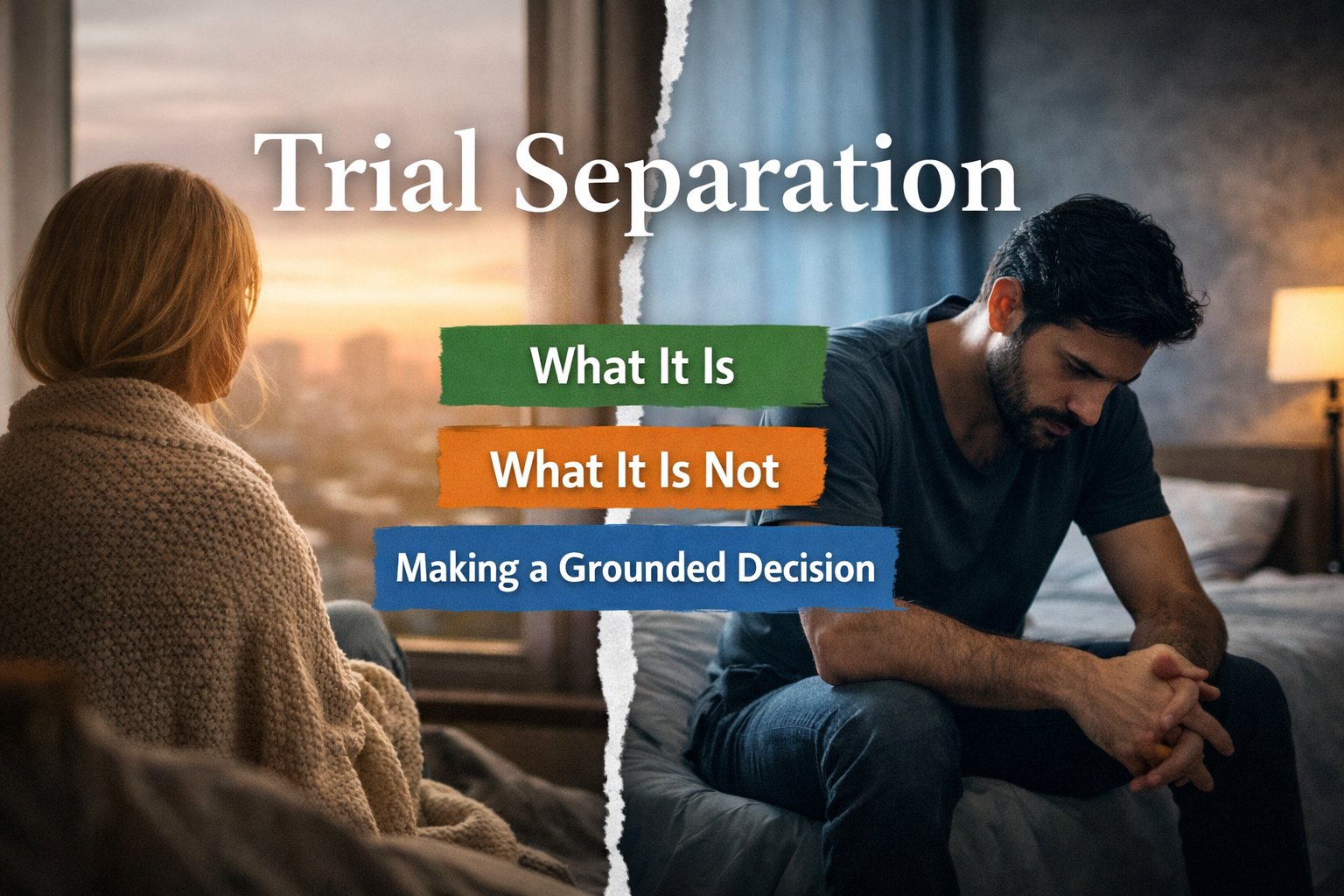
That's how most trial separations start. The trouble is that space on its own doesn't produce clarity. Couples can spend three months apart and come back to the same argument, just better rested. A trial separation can genuinely help you decide whether to stay or go, but only if you design it. This post covers what that design looks like, and what quietly wrecks it.
What Is a Trial Separation?
A trial separation is a time-limited period apart, agreed in advance, with a stated purpose: to work out whether the relationship has a future.
The agreed-in-advance part does most of the work. Moving out after a bad fight doesn't count. Neither does an open-ended break in which one person is quietly hoping, and the other is quietly leaving. Those happen constantly, and they tend to end in drift rather than decision.
When done well, the distance gives you room to think when daily contact has become too charged to think. Some people use the time to test whether reconciliation is realistic. Others use it to confirm what they already suspect. Both are legitimate outcomes.
How Do You Know If a Trial Separation Worked?
The research here is thinner than you'd expect, and most of it measures a single outcome: whether couples who get back together stay married. On that measure, the numbers are sobering. Most reconciliations after a separation don't hold long-term.
But staying married is a strange yardstick. A separation that ends the relationship cleanly, with less damage than a drawn-out collapse, has done its job. So has one that produces a genuine recommitment rather than a relieved truce. The honest measure is whether you made an actual decision, or just ran out of energy.
What Makes the Difference
Structure, mostly. Simply taking space doesn't lead anywhere on its own. Unstructured separation tends to increase rumination and anxiety, which is the opposite of what people go looking for.
The couples who get something useful out of time apart usually agree on a few things before anyone packs a bag:
• What the separation is for, said out loud and agreed
• How long it runs, with a date set to review
• How often you'll talk, and about what
• Practical arrangements, from finances to parenting routines
• Whether seeing other people is on or off the table, stated explicitly
Skip any of these, and the separation usually becomes a holding pattern that delays a decision you already know is coming.
What Belongs Inside a Trial Separation
Treat the separation like you'd treat any high-stakes decision at work: define the scope before you start.
A shared purpose. You won't agree on the outcome yet, and that's fine. Agree on the question instead. Something like: “We're taking this time to work out whether reconciliation is possible with real change, or whether separating is the right next step.”
A time boundary. Four to eight weeks is common. Three months is usually the ceiling. Past that point, the separation stops being a trial and quietly becomes the new arrangement.
Practical agreements. Money, parenting routines, who stays in the house, how often you talk and through what channel. Boring to negotiate, and exactly what stops the time apart from descending into logistics warfare.
Actual reflection. A separation hands you a lot of unstructured time alone with your own patterns. If you've never watched those patterns with someone trained to notice them, this is a good moment to start. You can read about how I work with Internal Family Systems here.
What to Keep Out of It
Some things reliably poison a trial separation:
• Leaving the end date open
• Using the distance to punish or test your partner
• Seeing other people without an explicit agreement about it
• Relitigating the whole history of the relationship every time you talk
• Calling it “working on us” while nothing changes in practice
The common thread is avoidance. When separation is used to manage anxiety instead of to answer a question, it deepens the confusion it was supposed to resolve.
What Distance Actually Reveals
Away from the daily friction, you find out whether you miss the person or just miss the absence of conflict. You also find out whether your hope is attached to who your partner is now, or to who they were ten years ago.
“Do I miss them?” turns out to be a weak question. Nearly everyone misses their partner in the first month apart; it proves very little. A stronger question: who am I becoming, with and without this relationship?
Your body often answers before your thinking catches up. Notice what happens in your chest and gut when you imagine walking back in the front door. Then notice what happens when you imagine the relationship ending. Neither reaction is a verdict, but both are information.
Questions to Sit With During the Separation
Come back to these more than once. Answers change.
• What do I notice in my body when I imagine returning? What shifts when I imagine ending it?
• Am I looking for clarity, or postponing a decision I've already made?
• Which patterns can I see now that distance has made them visible?
• What's mine to own in how we got here?
• If nothing about my partner changed, would I choose this relationship again?
Questions for the Review Conversation
When the agreed date arrives:
• What's become clearer for each of us?
• Has anything shifted in how we see ourselves, separate from how we see each other?
• If we reconcile, what would that require in practice? Be specific.
• If we separate, what would doing that with integrity look like?
• Are we choosing this, or defaulting to it?
Making the Decision Deliberately
A trial separation shapes the relationship whether you design it or not. Left unstructured, it usually prolongs the pain. Given structure and honest reflection, it can support one of the hardest decisions adults face.
Some relationships should end. Ending one deliberately, with care, beats drifting out through exhaustion. The same goes for staying. Recommitting because you've seen something clearly is a different act from staying because leaving felt too hard.
—-
Disclaimer: The reflections in this post are based on my own personal experiences and interpretations. They are offered for educational and self-development purposes only. Any reference to past relationships reflects my subjective perspective and is not intended to describe or make factual claims about any other individual.
If you're in the middle of this and want structured support while you decide, that's the work I do. I've written about using IFS during divorce if you want a sense of how I approach it, or you can book a discovery call.
Keep exploring
The Long Exhale
Prefer to keep exploring at your own pace? I write a short weekly letter on using your nervous system to make sense of a complex world. One email a week, and you can leave any time.
Double opt-in, so you'll get a quick confirmation email. Unsubscribe any time.